
Reducing Cognitive Overload in Veterinary E-Learning: Why Less is Often More
In veterinary education, clarity is more than a design preference—it’s a cognitive necessity.
We’ve all seen it: a beautifully crafted lecture that leaves students overwhelmed.
The problem may not be the content, but how it’s delivered.
This is where Cognitive Load Theory (CLT) can be a game-changer for veterinary instructors designing digital modules.
What Is Cognitive Load Theory?
Developed by John Sweller in the 1980s, CLT explains how learners process information using three types of mental load:
Intrinsic load: the inherent complexity of the content
Extraneous load: how the content is presented
Germane load: the mental effort required to build meaningful connections and long-term memory
In veterinary education, we can't always reduce intrinsic load—topics like fluid therapy, neurologic localization, or ECG interpretation are inherently complex. But we can reduce extraneous load, as well as maximize germane load all through intentionally using instructional design.
Why This Matters for Vet Ed
Veterinary students already face high cognitive demand. In a study published in the Journal of Veterinary Medical Education, students exposed to structured, simplified visual content had significantly higher comprehension and retention scores than peers using traditional dense slide decks (Morrison et al., 2020: Journal link) .
When content is poorly sequenced, text heavy, or layered with redundant narration, cognitive overload occurs—and learning halts and can even decline.
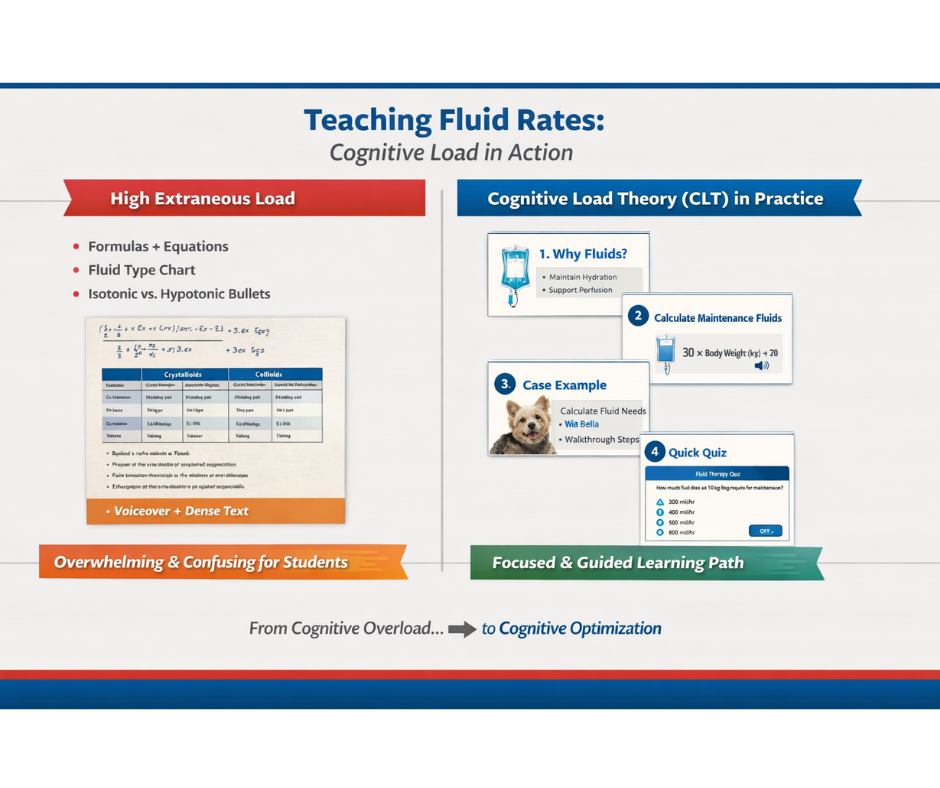
A Veterinary Example: Teaching Fluid Rates
Let’s say you're teaching maintenance fluid therapy in small animals. A cognitively heavy slide might show:
Three equations
A chart comparing fluid types
Bullet points describing isotonic vs. hypotonic uses
A voiceover reading the text out loud
That's a high extraneous load.
With this type of design, students are left to decode layout, listen to narration, and read and decipher text—all while trying to grasp new clinical math.
By using CLT, the content might be broken down like this:
Slide 1: “Why fluids?” (sets context and relevance)
Slide 2: Simple visual of calculation with narration only
Slide 3: One case scenario + guided calculation
Slide 4: Short quiz with feedback to reinforce transfer
Now, you’ve reduced split attention, minimized distractions, and guided learners through a manageable cognitive path.
Common Mistakes That Increase Load
Using walls of text and reading them aloud
Presenting multiple new concepts simultaneously
Overloading visual elements without alignment
Failing to signal importance or break content into steps
You Can Easily Apply CLT with This Quick Checklist:
Chunk content into logical, digestible sections
Pair visuals with narration, not duplicate text
Use worked examples before independent practice
Eliminate visual clutter and “busy” slides
Include low-stakes retrieval activities to reinforce germane load
Offer optional deeper dives for advanced learners (layered learning)
Final Thought
As instructional psychologist Dr. Ruth Clark notes:
“Cognitive Load Theory isn’t about making things easy—it’s about making learning possible.”
When we apply CLT to veterinary e-learning, we honor both the rigor of our content and the limits of working memory. The result? Better comprehension, stronger retention, and learners who are more confident when they step into the clinic.
